
CARAFE

We want pets, they say, we promise to care for them every Saturday.
My reply, about all the other days, makes them uneasy. They pivot.
But we will shut the door. They are clever with the non sequitur.
No you won’t, I say, and also, take the bag of coins out of your underwear.
Rats are smart!
I’m sure rats are brilliant, I say. I have heard about the ones who drive little cars and locate bombs, I say. But they also have sharp teeth, I think, and giant testicles that look very uncomfortable and I just can’t, I think.
I pull out the heavy artillery: If you can’t do a chore every day then you aren’t ready for a pet, I say.
Oh, may I clean the toilet? says the one who has no problem doing chores.
I WILL SORT THE ROTTEN FRUIT! says the offender, inventing a chore he likes better than the ones typically on offer. The toilet gets cleaned and the rotten fruit is sorted. The next day, the toilet cleaner inquires about the oven, her other favorite, and the rotten fruit sorter drives the vacuum at a run.
The weekend comes, and chores are happening. I attempt to replace the pets with an allowance. Ten dollars! Spend as you will!
The rabbit lover requests that we go to a toy store. I cannot say no to someone who loves cleaning an oven with infinitely delicate hands. We head east.
There is an interval during which I practice my breathing at Target. The rabbit lover has found a kitty: her 25th cat stuffie. It being her own money, however, I make no remark, or maybe one remark, and then pivot to the panic brewing in the next aisle. When I confirm for the other child that his only desire (a Blaster so big it cannot even lift it) is too expensive, the lid blows off the operation.
NEW THINGS ARE JUNK MOM WE NEED TO GO TO AN ANTIQUE STORE, my son erupts. I check the time. There is an hour until dinner, also known as snap peas and yogurt. I can afford to acknowledge that this dissatisfied customer is correct, new stuff is junk, excepting of course his sister’s cat stuffie, which we buy, and then head south.
When we get to the haunted industrial park woods surrounding the preferred antique store’s new location, the children know which roads to take and navigate for me loudly. We find a parking spot by the ravine edge and totter out.
The children enter the huge industrial space expertly, and my son in his two-sizes-too-large boots begins the urgent, manic clomp of his accustomed circuit. Emboldened by chore money, he drags his companions from stall to stall at a slightly higher pace than usual. My purse keeps falling off my shoulder and by the time we’ve entered the second circuit (he is narrowing in on a target in earnest), the antiquer’s sister begins to complain of sore feet.
I need a fancy potions bottle, he announces at the start of lap three. This is a relief, because the white noise of the conflict-static rising from his head, as he tries to learn what it is that he so very much needs, has been fritzing out his sisters’ and my radio antennae. The declaration of intent at least means we can be of use. OK, fancy potions bottle, and now all three of us are searching with the kind of intensity that makes you drool.
*Note: this child’s main birthday gift was the continually requested antique round-wick oil lamp with a tall funnel and a real glass shade. The other child’s was kitties numbers 23 & 24.
I show the antiquer several very nice, shapely items that look like fancy potions bottles to me, as best I can with his sister riding on my back, but these proposals are disqualified immediately, though he can’t say why. Slowly I come to understand by process of elimination that the desired bottle should also be large, and colorful. I begin to suspect, with no small amount of dread, what I should have known all along, which is that it should also be gilded.
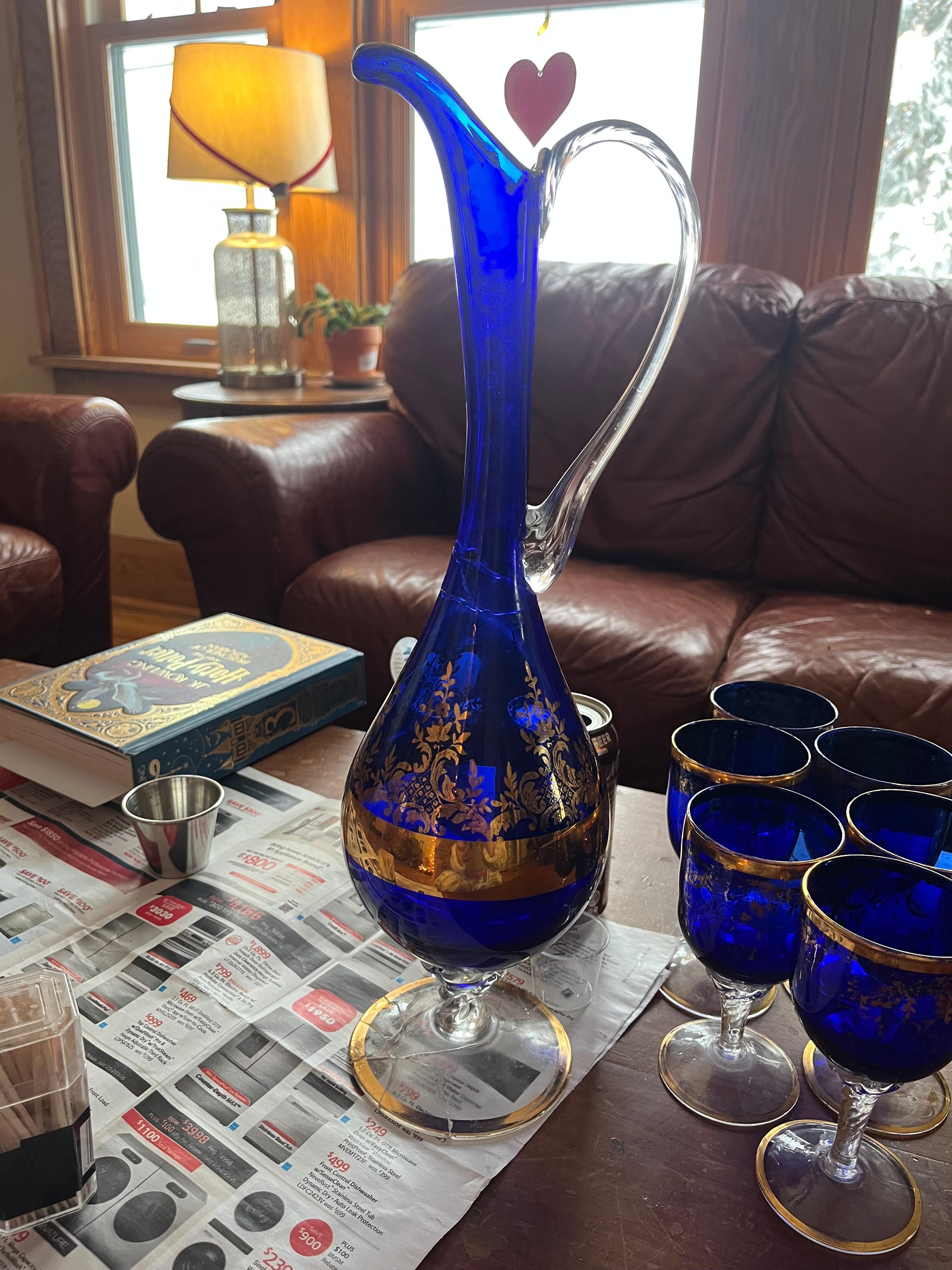
The search has become so narrow at this point that I’m having my first actual fear that we may not find an acceptable prize. Then I hear a shout. The child is standing in front of a twenty-four inch gilded cobalt glass carafe with six matching port glasses.
I gird my loins to check the price tag. To my amazement, it is only $28.
We pause for a brief discussion about the rest of the money he has to his name— roughly forty further birthday dollars, mostly in single bills, which he has such a tendency to use as decoration for forts that we’ve taken to keeping all of it for him in the kitchen junk tin. I reckon aloud that if he adds his fruit-sorting money to his confiscated dollars he will have enough for the carafe and glasses.
He nods sturdily as a stone mason, seizes the slender glass vessel by the neck, extracts it from the display without a sound, and makes for the checkout counter. We are now in the hands of fate. My role at this point is purely supporting. I tail him, sister with the sore feet now riding on my back and six gilded port glasses in my hands.
“Some of my colleagues started at this age,” the salesperson at the register says, eyeballing the glowing carafe owner as she wraps his bounty in sheets of brown paper. Each glass goes into a slot in a spare wine box, and the carafe itself rises above the top of the box like a lone heron surveying us all calmly.
When we get to the car, he says he will hold the box in his lap. No, I tell him, it’s too big and fragile. He clarifies the situation for me with some cellularly felt moans: it is not only an affront but a spiritual severing to separate him from his cobalt carafe on the drive home, which he knows is likely to be nearly twenty minutes with traffic. because I am too tired at this point to endure his grief if I do not, I agree to let him hold the vessel itself.
At home, the carafe and its glasses are unloaded and arranged in various configurations. The favorite setup seems to be the tall slender spectacle at center with acolytes surrounding. There are explorations of the “tinking” sound capacity for each glass, using toothpicks, because we are wise, and do not use metal for the tinking. Then, at last, we begin the pouring portion of the evening.
Kitty 25 watches patiently, the faux-pearl necklace she nabbed at the counter of the antique shop adorning her skinny rainbow neck. Kitty 25 is served first water and then ginger ale and then tea. The evening, astonishingly, goes without incident.
It is the next day, from the far bathroom, that I hear the smashing sound. A slow wail rises and blooms into despair as I rush to the scene. I know several things, before I make it there, just by the particular music of the disaster: that it must be the carafe, that no one is physically hurt, and that it will not be fixable.
When I arrive in the bathroom, the child is up on the sink stand, holding the neck and handle of the carafe. there are shards and granules and molecules of glass everywhere. I was just trying to fill it, he sobs.
I tell him to hold still and quickly gather the largest pieces and stick them in a small box nearby. I would airlift him out but I know he would refuse. He is honorable this way, and would stay near any maimed loved one as he does by the remains of the carafe.
I make all the musics of empathy and sadness. It’s so sad, I say over and over. Soon, he begins the rage-grief sine wave, alternately roaring about the stupidity of fragile things and sobbing over his loss. It’s no use to try distraction, and he won’t let me hold him. Humor is completely useless here, in the land of desolation. So I sit with him and wait for an opening. Any pause, any stutter, any hesitation in the tsunami. There is none.
I try vacating to let him regulate himself.
Ha.
Then, as usual when my children are inconsolable for extended periods, I do something perfectly ridiculous.
“Would it help,” I say, and close my eyes as I realize what’s about to come out of my mouth, “if I tried to fix it?”
The wailing stops dead. He sniffs.
Oh, sure! Yeah, that’d be great! he says, and jumps down, already on the way to what he supposes are the fixing-grounds.
“It may not work,” I call after him, very clearly, but he is already certain it will. Don’t worry, mom, you can do this.
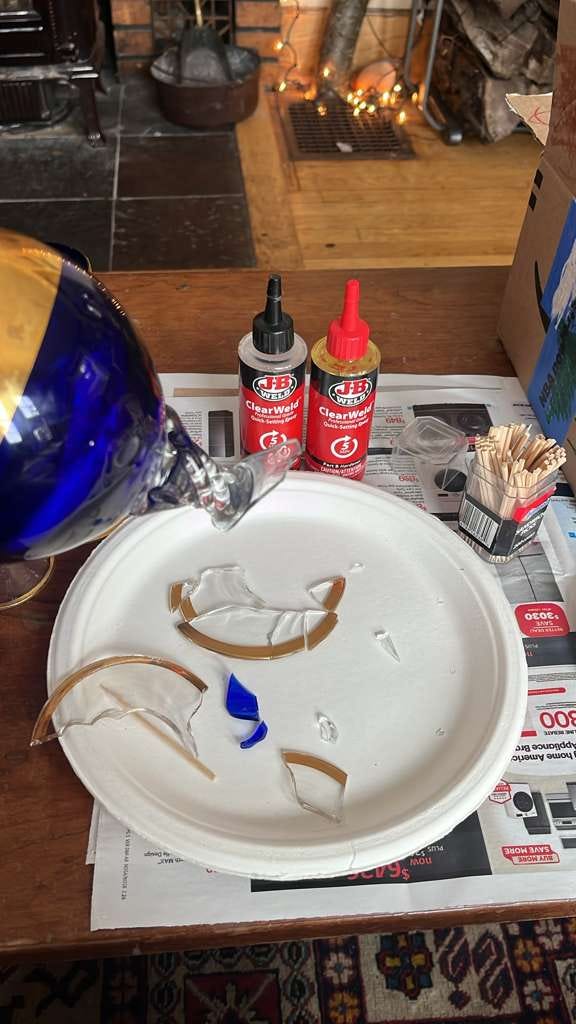
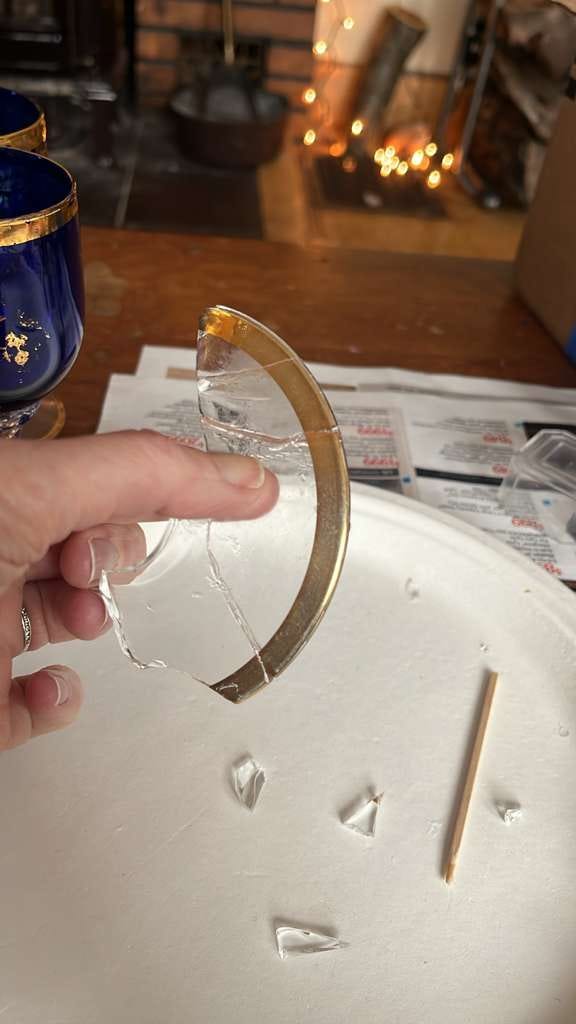
In the box, there are no fewer than nineteen pieces of glass, some ten inches or more, and others less than half an inch square. All I have is epoxy and desperation.
I open the windows to the freezing outdoor air, put on a vest and hat, toss some snacks and instructions not to come anywhere near me to the children, assemble toothpicks and paper plates and paper towels, and try to lay out the pieces in the order I think they might need to go.
Each joining, I find out very quickly, really does require that I sand all the edges with 220-grit sandpaper first, or else the piece, no matter how long it’s held or how carefully it’s balanced, simply slides off its neighbor.
Very well, now I am sanding shards of glass, while my son hovers around me like a deerfly, saying Mom I love you, you’re doing amazing, and bumping into me and the table, saying and doing ceaselessly enthusiastic things with his body, all of which disturb and attenuate the process.
This goes on for about three hours, at which point we go somewhere to escape the epoxy fumes. I don’t remember where, likely because I had glue poisoning. There may even be an extra day in there somewhere.
When we return, the multiple assemblages I have made and balanced in various places along the mantelpiece in order to keep them out of reach are still in place, and have remained solid. Maybe it IS going to work??
That evening, of whatever day it is now, I finally get the number of parts remaining to be joined down to three: the carafe proper and the two sides of the base (which are completely gummed over with epoxy smudge but holding steady so no one is complaining). I opt to join one side first, so that the collage can be balanced idiotically from a seltzer package to cure until it’s ready for its final piece.
After dinner, I go back and see that it’s all held together, somehow, and there’s just the final half of the base to join. I sand it, mix the glue (it has to be done in dozens of tiny batches because it hardens so quickly), and line it up. I go to place it in, and it does not fit.
Everything looks almost perfect, but there’s a whole edge along which the angle is just wrong, and if I pursue it and put the glue on anyhow, the base will be too tilted, completely nonfunctional. So I sand it, for twenty more minutes, just hoping that I can somehow bring the differential down enough for the whole jagged rift to click into place. In the end, it doesn’t so much click as it crunches. But nothing falls or shatters.
In the morning, I go to the seltzer box and peer down at the severely damaged, bird-like, glue-smudged artifact. I pick it up and walk over to the table. I set it down. IT STANDS. Nothing falls or breaks or explodes. I poke it. It doesn’t wobble. Soon, it occurs to me that this thing is now about 19% epoxy by weight, and at least that much stronger than it was before.
I yell GUESS WHAT up the stairs to the still-waking chore-doers. I say nothing else. They come thundering down.
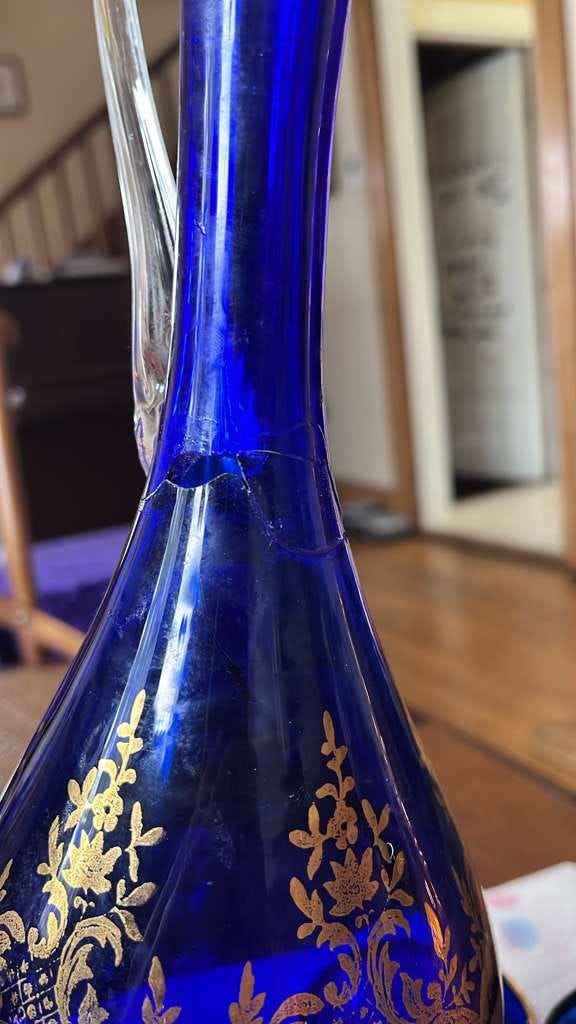
The antiquer looks satisfied. He nods. Maybe we can find a piece of sea glass to close that gap in the neck, he says. I agree. For now, the thing has a tracheotomy hole, since there was one final shard we never found. It’s not the kind of edge he can cut himself on, though, so I don’t say anything when he seizes it like a beer stein and carries it to the dining room for its next round of duty.
I suggest mildly that we keep the recovering carafe’s duties light for a while, and the child silently agrees.
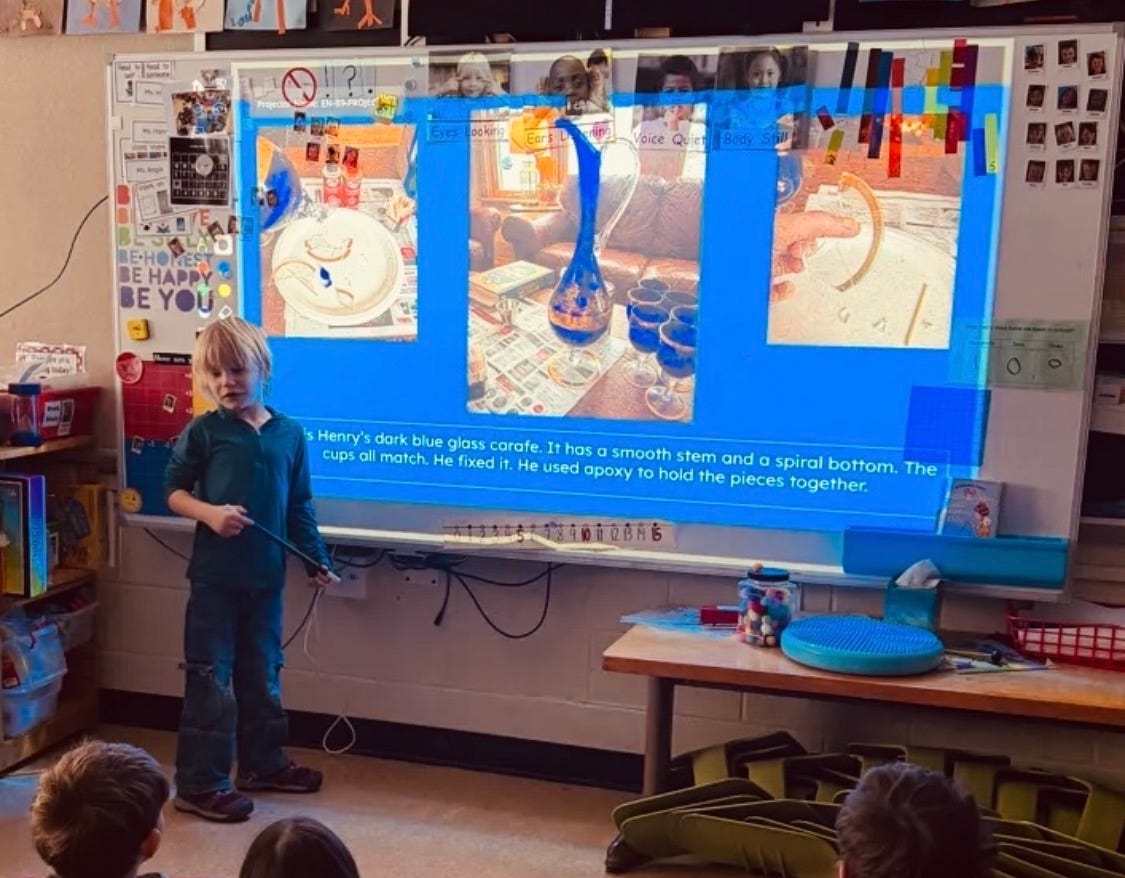
About an hour later, after the kids are fed and clothed and bundled and shoveled onto the bus, I get a text from my son’s teacher through the classroom communications app. I have forgotten that it’s his share day, his day to make a presentation to the class about something he cares about. “Could you send me a picture of the ‘blue glass carafe with a twisted bottom and six matching glasses?’” the teacher texts me. I round up what pictures I have and send them.
Now. It should be known that this particular child struggles with debilitating self-consciousness. It’s taken him seven years to quit going into a terrified rage when people sing the birthday song, for example. We hold our breath whenever some well-meaning idiot stranger points out something he’s doing, wondering which bookshelf’s going over in payment for his having to bear the injury of scrutiny or attention.
After school, I get one last text from the teacher. “H was an accomplished presenter today,” she writes. “He sure loves an audience!”
I glance over at the carafe, still standing on the coffee table, waiting for its owner’s return, somehow not falling apart.
In such times, what else can one think, but “cheers”?

Well, you’ve put me through the emotional wringer and it’s only 7:16am! Honestly, Caro, from giggling over your hilarious recounting to the pinpricks of tears seeing the photo of Henry sharing his story at the end (and seeing the heron carafe itself!), you’ve made my day!🙏❤️
A not-so-small-miracle here in every way I can think of. It takes dig-deep patience and dexterity to shepherd your wild little flock and it’s so awesome and hilarious to witness.